Expert Slide and Photo Scanning Since 2002
4000 ppi High Resolution Slide Scanning
Affordable Scanning
www.old-photo.com
www.old-photo.com
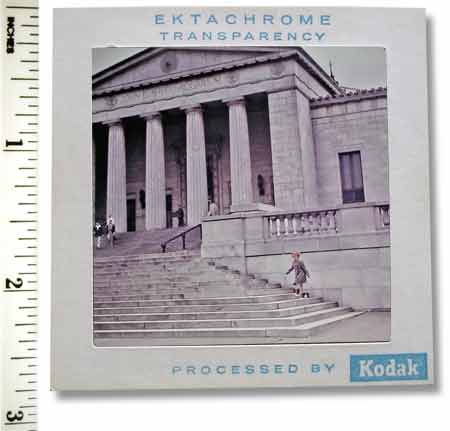
120 Film Square Slide Scanning
Our charge for scanning 120 format film in slide carriers such as the one to the right, is $2 per slide. They are scanned at 1200 ppi per slide. (Some people refer to these slides as 55mm.)
Click here for our 120 slide order form.
Please note that we do not develop your large or medium format 120 or 620 film (620 film was similar to 120 but had a "thinner" spool) for you.
120, 620 Medium Format Film:
A Brief History:
The Medium format film was created
specifically for the Kodak Brownie cameras back
in 1900-1901. It was a very simple camera that
was basically, fixed focus and "point and
shoot." It had a single shutter speed. The
"Brownie" camera took its name from cartoon
characters that were popular at the time
depicting mischievous but good hearted elves.
Medium format means 120 and 220 size roll film.
The film is on a spool rather than in a
cassette.
Just about every emulsion from the major film
companies was available in 120 film. Most were
available in 220 as well. The difference between
120 and 220 film was that 220 was twice as long
and therefore holds twice as many images as 120.
The spool sizes were the same. What differs is
that 120 film has a paper backing that runs the
full length of the film. 220 film only has a
paper leader. Thus more film can be wound in the
same space with 220. If you have 35mm negative films that need to be
scanned, please see our negative page.
120 film allows several frame sizes.
| Name | Aspect ratio | Metric size (mm) |
Exposures | |
|---|---|---|---|---|
| 120 | 220 | |||
| 6 × 4.5 | 1.35:1 | 56 × 41.5 | 15 or 16 | 30-32 |
| 6 × 6 | 1:1 | 56 × 56 | 12 or 13 | 24-27 |
| 6 × 7 | 1.25:1 | 56 × 70 | 10 | 21 |
| 6 × 8 | 1.37:1 | 56 × 77 | 9 | 19 |
| 6 × 9 | 1.50:1 | 56 × 84 | 8 | 18 |
| 6 × 12 | 2.1:1 | 56 × 118 | 6 | 12 |
| 6 × 17 | 3:1 | 56 × 168 | 4 | 9 |
| 6 × 24 | 4:1 | 56 × 224 | 3 | 6 |
The 6×9 frame has the same aspect ratio as the standard 36×24 mm frame of 135 film. The 6×7 frame enlarges almost exactly to 8×10 inch paper, for which reason its proponents call it "ideal format". 6×4.5 is the smallest and least expensive roll-film frame size; equipment to take photos in this size is also the lightest.
The wide 6×12, 6×17, and 6×24 cm frames are produced by special-purpose panoramic cameras. Most of these cameras use lenses intended for large format cameras for simplicity of construction.
Cameras using 120 film will often combine the numbers of the frame size in the name e.g. Pentax 67 (6×7), Fuji 617 (6×17), and many 645s (6×4.5). The number '6' in general, and the word 'six' are also commonly used in naming cameras e.g. Kiev 60 and Pentacon Six.
The 105 format was introduced by Kodak in 1898 for their first folding camera and was the original 6×9 cm format roll film. The 117 format was introduced by Kodak in 1900 for their first Brownie camera, the No.1 Brownie, 6×6 cm format. These formats used the same width film as 120 film, but with slightly different spools. The 105 spool has a much wider flange, similar to the 116 spool. The 117 spool is slightly narrower than the 120.
The 620 format was introduced by Kodak in 1931 as an intended alternative to 120. Although mostly used by Kodak cameras, it became very popular. The 620 format is essentially the same film on a thinner and narrower all-metal spool (the 120 spool core was made of wood at that time):
* 120 2.466" width, 0.990" flange, 0.468" core
* 620 2.468" width, 0.905" flange, 0.280" core
Hence the 620 is sometime referred as "small hole" 6×6 or 6×9 as opposed to 120 "large hole". The 620 format was discontinued by Kodak in 1995, but it is possible to rewind 120 film onto a 620 spool in the darkroom for use in 620 cameras. According to Kodak, the narrower metal spool allowed building smaller cameras. Nonetheless the 120 format cast-metal bodied Voigtländer Perkeo remains smaller than any 620 format camera.
About Our Company
Affordable Scanning Services LLC
400 Bittersweet Lane
Waupun, WI 53963
Copyright 2023
Everyone needs to fill in and submit an order form online. This includes those who want to personally DROP OFF. There is a lot of information you need to read on the order form pages.
Please click here.
Get in Touch
After Hours, you will get a faster response by using Email. Please click the link above. We answer Email at all hours. Telephone messages are responded to during business hours.